
“Before time itself was measured, the Voice was speaking. The Voice was and is God. This celestial Word remained ever present with the Creator; His speech shaped the entire cosmos. Immersed in the practice of creating, all things that exist were birthed in Him. His breath filled all things with a living, breathing light—A light that thrives in the depths of darkness, blazes through murky bottoms. It cannot and will not be quenched.” John 1:1-5 Voice
How easy it is to become narrow and colloquial in our thinking about a boundless God. How natural for us to rationalize our perceptions, because contemplating His immensity is terrifying! Like CS Lewis illustrates so beautifully in his Chronicles, Aslan (Jesus) is not a tame lion”. We fence Him into our boundaries of understanding so as to hold Him at bay. He hides from plain view so that we can. Our current illusion of historical superiority allows us to diminish God’s intrusion into humanity to a mere set of archaic fables or mythological stories – an interpretation by Jewish culture to make sense of their history. One gift of living at this time in history, however, is that we have the capacity to dissect and understand cultural implications of the language like never before. Whereas a few literate men used to be totally in control of the translation and nuance of revelation, we now have a cadre of linguists, investigators and scholars who have access to material that at one time was available to only a few men. Women as well are lending another vantage point that was previously absent from the process. The Voice translation of John 1 is a beautiful demonstration.
John’s ethereal prologue to his Gospel narrative contrasts with the more biographical ending where he says – after recounting the incident of a skeptical Thomas – “Jesus performed many other wondrous signs that are not written in this book.These accounts are recorded so that you, too, might believe that Jesus is the Anointed, the Liberating King, the Son of God, because believing grants you the life He came to share.” John 20:30-31 Voice
We begin hearing of Jesus’ activities as John’s contemporary with a reminder of Who it is we are talking about – the very One Who participated in the concept and creation o’f an astounding universe. Just today I read that our powerful telescopes have discovered celestial bodies that defy our current understanding of astronomical activity. “Jupiter-sized “planets” free-floating in space, unconnected to any star, have been spotted by the James Webb Space Telescope. What’s intriguing about the discovery is that these objects appear to be moving in pairs. Astronomers are currently struggling to explain them. The telescope observed about 40 pairs in a fabulously detailed new survey of the famous Orion Nebula. They’ve been nicknamed Jupiter Mass Binary Objects, or “JuMBOs” for short.” Jonathan Amos – science correspondent for BBC News
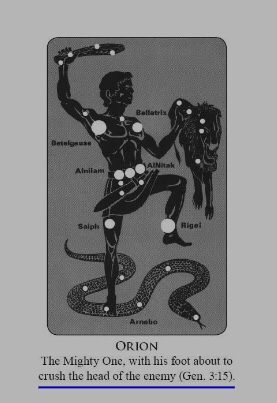
Man, I love astronomy! It has tickled our imaginations since Adam! And this discovery found in the Orion nebula no less! “Orion is to remind us of that coming glorious Prince of Light. In one hand He holds a great club and in the other hand the skin of a slain lion. This shows His victory over the ‘roaring lion,’ who is Satan. At the feet of mighty Prince Orion is the serpent. One foot of the Prince is raised to crush its head. The bright star that marks that foot is called Rigel, which means The Foot That Crushes. The star in the other foot is Saiph, which means Bruised, the very word that God used in speaking to the Serpent: ‘You shall bruise Him [the seed] on the heel.’” God’s Voice in the Stars – Ken Fleming
Our Jesus knows the name of every single star. He knows your name as well, and how many hairs on your head at any given moment. The descriptor ‘logos” that launches John’s eye witness account of Him drips with intriguing connotation. Let me quote the Voice insert on this point:
This Gospel begins not with Jesus’ birth or John’s baptism but with a deliberate echo of the creation story in Genesis. It takes us back before time began to the moment when God interrupts the silence and speaks the cosmos into existence. Only John’s Gospel names Jesus as the Logos and declares that He existed long before time was measured. This Greek word carries a variety of meanings, all relating to the act of speaking …John’s use of logos is unique and has often been rendered as “Word.” While this is a useful translation, even a casual understanding demonstrates that “Word” reflects only part of its meaning. Most readers will interpret “word” as a unit of language—a combination of sounds generally spoken but also written—that carries meaning. To understand what John means, readers need something more than their cultural understanding of “word”; they need a new way of thinking about it. This is why we have chosen to offer another rendering, an interpretive, poetic translation, of what may be one of the most theologically loaded words in Scripture. Since logos essentially refers to the act of speaking or bringing thoughts to expression, we have decided to use the word “voice” to capture that reality. John declares that truth has culminated in the person of Jesus. No single word captures the complete meaning of logos, but “voice” has a number of advantages.
First, “voice” manifests the act of speaking. Voice is that which is spoken and that which is heard; it comes on both sides of any communication event, bridging the gap between sender and receiver. John intends that in Jesus God is speaking and revealing Himself to the world.
Second, a voice is distinct and personal. We can distinguish people from one another simply by their voices. In John 10 Jesus describes the fact that the sheep hear the voice of the shepherd when he calls and they follow, but they refuse to follow a stranger because they do not know his voice (John 10:1-5). John desires that we know Jesus as the Son of God and believe in Him personally as the Good Shepherd.
Third, “voice” is dynamic in that it reflects the robust and powerful activity of a living God. It is historical in that any act of speaking comes to expression and takes place in the real world as a “voice” calling, demanding a response. It challenges any notion that the Christian faith can be reduced to rules, propositions, or doctrines that can be merely believed or dismissed and not lived out in our lives. Since in Jesus God is speaking and revealing Himself to the world, and since in Jesus we hear the Voice of God, then this new reality changes everything so we, too, must change.”
This insightful explanation calls us to conversation, to interaction. John’s ‘voice in the wilderness’ calls for preparation to listen. God’s voice in revelation, His voice in creation, His voice in the stars all call to relationship – not rules. He wants us to learn His loving shepherd’s voice in our own lives. What a God!! He is not only accessible but hopeful that we will interact with Him. He came a long way and paid a great price to engage us. So we can believe! And live. With Him!
“He who has ears to hear, let him hear!”
Shalom!
 salt-shaker.blog
Leave a comment