

CLICK ON THE TOPIC TO TAKE YOU TO THE VIDEO
- God’s Goodness (Reading)
- How can a good God send people to hell?
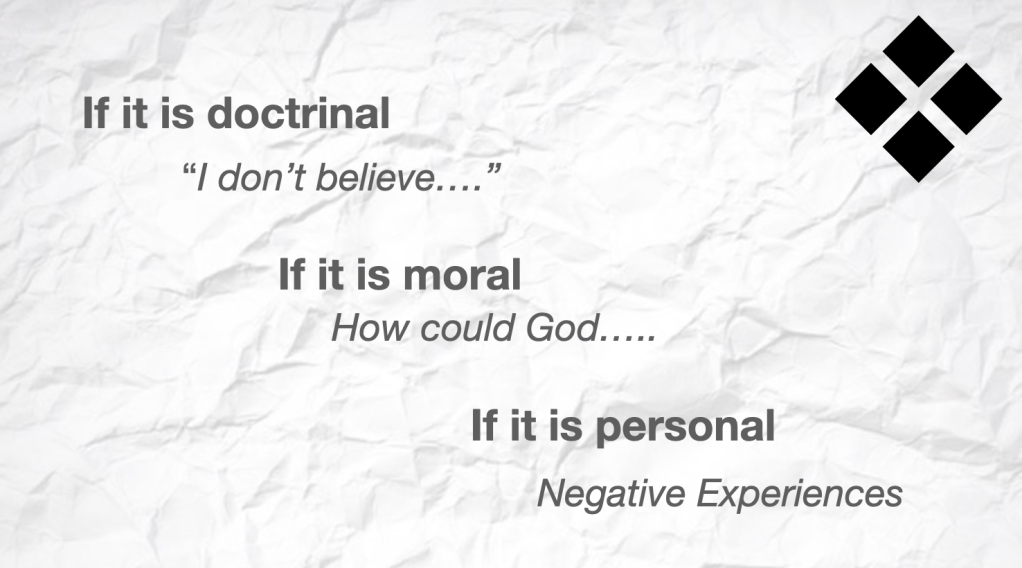
- Categorize the type of objection you are facing
- What the Bible Really Says About Suffering
- Answer the person not the argument
- INSTRUCTIONAL VIDEOS
- The question that stops Christians
- Use stories from Scripture to answer ?’s
- Apologetics remove obstacles
- How to better answer ?’s
- How to approach the subject of Hell
- What about those who never heard about Jesus
- MORE INFO
- Can you answer these questions
- A challenge to the moral argument
- QUESTIONS
- WHAT ABOUT THE BIBLE?
- Contradictions?
- Is the Bible Reliable?
- Are there errors in the Bible?
- VARIOUS OBJECTIONS
- Jesus has affected everything
- Do morally good people go to heaven?
- Is God a moral monster?
- Is truth objective?
- How can we know truth?
- SCIENCE
- Science proves God’s not dead
- So much science cannot explain
- What about evolution?
- Creation story and science
- Evidence beyond nature
- Age of the earth
- Did the Universe Come from Nothing?
- Fingerprints of God
- PHILOSOPHICAL CONSIDERATIONS
- Christianity over all other religions
- Why Is there sin and suffering
- 3 answers for atheists
- God does exist
- Are all religions the same?
“Every new generation must find ways to communicate the Gospel clearly and strikingly, distinguishing it from its opposites and counterfeits.“
Tim Keller
Stephen Meyer, a proponent of “Intelligent Design” creationism, and Wes Huff, a biblical scholar, answer some great questions from Joe Rogan
God’s Goodness
 The classical argument from antiquity is, “If God could and is good, he would” prevent the death of this child (or whatever situation is at hand). This is the only argument of status against the existence of the Christian God. As with pain, many insist that if God were both all-good and all-powerful, he would not permit the evil things that do happen to occur at all. In the face of this problem, one is prone to think the deadliest of thoughts, namely, that God is not good or that he is not able. But if moral evil exists, aren’t we forced to let go of one or the other?
To deal with this effectively, we need to understand the level of God’s daily interaction in the realm of human affairs. Does God do everything there? Did he butter your toast this morning, drive your kids to school, write checks to pay your bills? No. Of course not! Human beings act too, and nature moves along in some degree on its own. All of this must be taken into consideration. So what we must look at is the question: Did God do well to create a world in which there is free personality and natural law, such that it includes the possibility of a kingdom of God as well as the possibility of evil?
Can we agree that many things ought not to be, without holding that the general framework that permits them to exist was a mistake on God’s part? This returns us to our discussion of God’s purpose within human history, which is to create for himself a living abode—a community of free, conscious, living beings. Could God have done this in a better way?
The world that contains the possibility of evil is the one that also contains the greatest possibility of good. And the question of why God allows evil to happen has to be put against the question of what a world where evil could not happen would be like. It’s by working on those questions that people can come to some resolution in their minds about the reality of evil and what it means.
The Allure of Gentleness: Defending the Faith in the Manner of Jesus Dallas Willard
Decide which category the objection fits into
INSTRUCTIONAL VIDEOS


Where are you?
Why are you crying out to Me?
Can these bones live?
Is it right for you to be angry?
Who do you say that I am?


 salt-shaker.blog